Nuclear-Capable Aircraft Systems Explained
What are nuclear-capable aircraft, and what should you know about them? This blog seeks to provide a profile on nuclear-capable aircraft, following their increasing relevance not only in European defence but in different geopolitical contexts around the world.
Information disorder during Operation Spiderweb
To see why nuclear-capable aircraft grab so much attention, we can examine a recent example. In June 2025, Ukraine conducted Operation Spiderweb, in which they targeted 5 Russian air bases where nuclear-capable bombers were stored. This caused extensive damage to Russia’s air leg. The action destroyed an estimated $250 million in air capabilities, making it one of the most successful operations of the Russia-Ukraine War.
On Reddit, inflated and unverified messages quickly appeared claiming “the entire Russian strategic fleet has been compromised” and hit aircraft were conflated with destroyed aircraft. We also once again saw footage from the video game Arma 3 appearing. A YouTube channel with over 100,000 subscribers shared a video claiming this was possibly the start of World War III, and, notably, ‘explaining’ that Russia “can’t launch nukes now (because they have) limited ability to deliver anywhere in the world.” In reality, it is important to understand that damage to aircraft, even if real and significant, does not equate to a collapse of Russia’s nuclear delivery capability. In addition, and this is where this blog post comes in, strategic bombers can carry nuclear weapons – but do not always do so.
EuroVerify created a video about the Arma 3 footage, highlighting that it was a case of accidental amplification: the channel mentions that the footage is not real, but not everyone watching understood this, or intentionally decided to ignore that.
What are nuclear-capable aircraft?
Stories like the above often cause confusion about what nuclear-capable aircraft actually are, so we are going to break it down. We use the term “nuclear-capable” to describe a weapon delivery platform capable of carrying and employing nuclear warheads. This article will explore this in the context of aircraft delivery.
You might think that nuclear-capable aircraft are always armed with nuclear weapons – which is an easy conclusion. However, “nuclear capable, in reality just means that that the aircraft has the capacity to do so.
Another distinction is that a nuclear-capable aircraft is not synonymous with it being nuclear powered. A nuclear-powered aircraft is one with a nuclear propulsion system, meaning that it uses nuclear energy as its main power source or energy supply. Very few nuclear powered aircraft have been produced and none have ever made it beyond proof of concept.

Air bases and air power have historically been markers of national pride and power. This rings especially true in a nuclear context, seeing that just 9 countries are (believed to be) nuclear-armed states. Not all have indigenous aircraft production, although it should be assumed that all nuclear armed states, if necessary, can utilise aircraft for delivery and employment. We will look at how these aircraft fit into a country’s overall defence and deterrence strategy a little later.
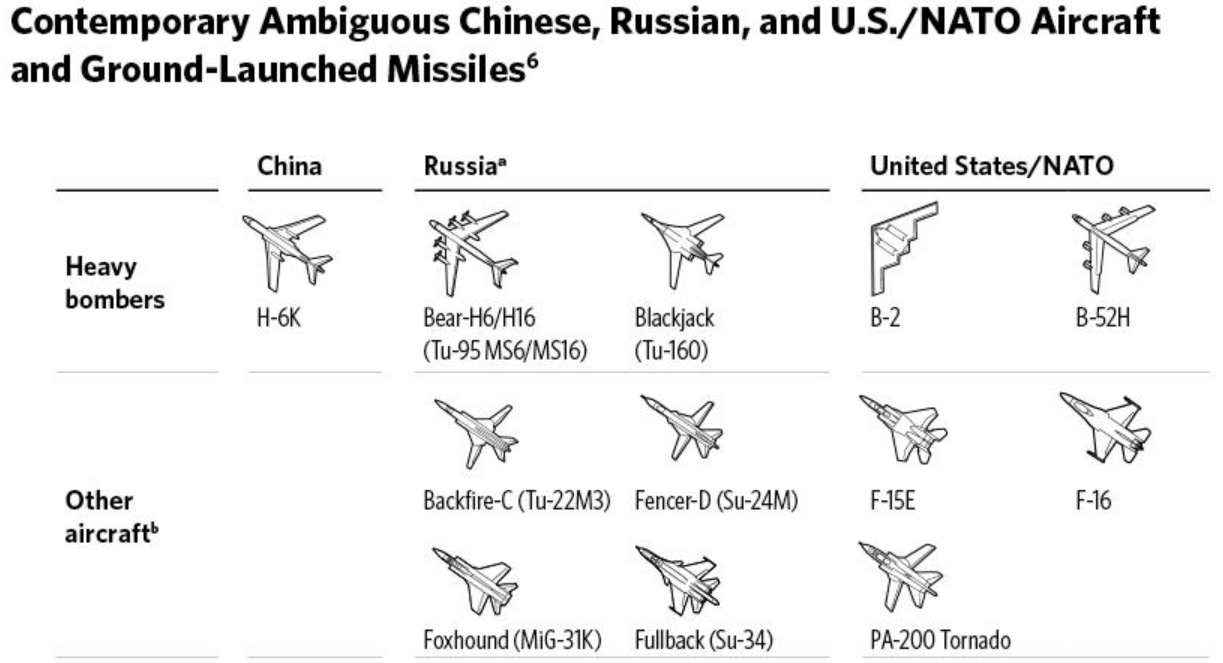
Table showing the nuclear-capable aircraft of some nuclear weapon states, not including the F-35. Source: Nuke or Not, James Acton.
Historical context and strategic role of nuclear-capable aircraft
Understanding the aircraft themselves is just one piece of the puzzle. We also need to explore their historical role and strategic importance. Namely, aircraft armed with nuclear warheads are exceedingly rare since the end of the Cold War. The U.S. ended Operation Chrome Dome flights in 1968 and bombers now generally carry nuclear weapons only for training or on standby at secure bases. The Soviet Union, and later Russia, has not resumed continuous airborne nuclear alerts — a practice in which bombers are kept armed and aloft 24/7 — though it maintains nuclear-capable bombers on high readiness and conducts periodic training and long-range patrol flights.
While accidents have occurred, extensive safety and security measures surrounding nuclear-armed aircraft mean that the chances of accidental detonation are near zero. Cases of nuclear-related accidents – known as ‘broken arrows’ – are rare. The majority of incidents occurred in the 1950s and 1960s, a time of high tensions and arguably less advanced safety technology. In instances where fires or crashes occur near nuclear weapons the chances of detonation are one in a million. For once, history brings comfort in this case: nuclear-capable aircraft have been hit in the past “and the nuclear weapons did not detonate”. The U.S. Department of Defense officially lists 32 “Broken Arrow” nuclear weapon accidents between 1950 and 1980 without catastrophic consequences – highlighting the effectiveness of both safety systems and command strategies. Bottom line: none of these accidents resulted in nuclear explosions or major threats to global stability.
Why targeting nuclear-capable aircraft may be less critical than it seems
Even though these aircraft have a powerful history, the reality of their risk is more nuanced than headlines suggest. To make sense of this, it helps to look at how nuclear-capable aircraft are actually armed and managed today. It is a complex process that relies on multiple technological safeguards, including permissive action links (PALs) that prohibit unauthorised use. PALs are electronic devices “that prevent arming the weapon unless the two correct codes are inserted into it [...] simultaneously or close together”. For example, making the F-35 (Lockheed Martin stealth fighter jet) nuclear-capable required “two major hardware component modifications, [...] a nuclear consent switch in the cockpit, and a mission select switch in the weapon bay”. It is very important to understand that even if an aircraft is nuclear-capable, it is not just sitting there ready to go – it takes multiple layers of authorisation to arm a weapon. With that said, do keep in mind that this example is presented here because the US government and NATO have made this information public. There is little to no information publicly available about nuclear-capable aircraft that fall outside this remit.
Misconceptions about nuclear-capable aircraft and risk management
It is understandable that people feel concerned or alarmed when nuclear-capable aircraft are hit, especially if they assume the aircraft are armed with nuclear weapons. Information surrounding exact locations of nuclear-capable aircraft worldwide – and whether or not they are armed – is not released to the public. This means it is difficult to quickly check these claims online. However, “neither Russian nor US non-strategic nuclear weapons are operationally [...] mated to delivery systems, on a day-to-day basis.” In other words, nuclear-capable aircraft are not regularly armed, meaning a reduced risk of nuclear accidents. Furthermore, it is worth noting that non-strategic nuclear weapons are counterforce weapons, meaning that they are to be used against an actor’s military force or on the battlefield only.
Besides accidents and all-out war, a more realistic – though still unlikely – concern is warhead ambiguity. I.e. “The likelihood of mischaracterisation or uncertainty about how a weapon is armed”. Because nuclear-capable aircraft are not always armed with nuclear weapons, an adversary may not be able to distinguish between conventional or nuclear-armed aircraft. This dual-capable status can create uncertainty in a crisis, which may influence decision-making and escalate caution. However, modern doctrines and signalling mechanisms – such as formally articulated declaratory policies and communication channels developed through Nuclear Posture Reviews — are designed to clarify intent and reduce the risk of misinterpretation in crises.
Zooming out: nuclear weapons and deterrence
Stepping back, it is important to be aware of how nuclear-capable aircraft fit into nuclear deterrence. Nuclear weapons are qualitatively different from conventional weapons because of their immense destructive power and potential for long-term effects. Deterrence theory and doctrines such as mutually assured destruction (MAD) rest on the idea that the catastrophic consequences of nuclear use make escalation to nuclear war far more dangerous and less likely than escalation within conventional warfare. Some scholars will describe nuclear weapons as tools of deterrence and signalling. In other words, they exist to convince opponents that the costs of escalation would be too high. However, this does not eliminate the real possibility of miscalculation or crisis instability that could draw nuclear powers into using them.
In any case, only a small number of countries actually operate nuclear capable aircraft. Some NATO countries (namely Belgium, Germany, Italy, the Netherlands, Türkiye and the United Kingdom) maintain aircraft that could carry U.S. tactical nuclear bombs under NATO’s nuclear sharing arrangements, but in practice the bombs are tightly controlled and their use is highly restricted. Most of these aircraft are only used for training and deterrence purposes, not for active combat. Even among nuclear-armed states, the likelihood of these planes being attacked – or used in a conflict – is extremely low, making them more of a strategic tool than an immediate danger. Because of their limited scope, the targeting of nuclear-capable aircraft narrows down the number of actors and consequently the context in which those actions are taken.
Recent incidents involving nuclear-capable aircraft
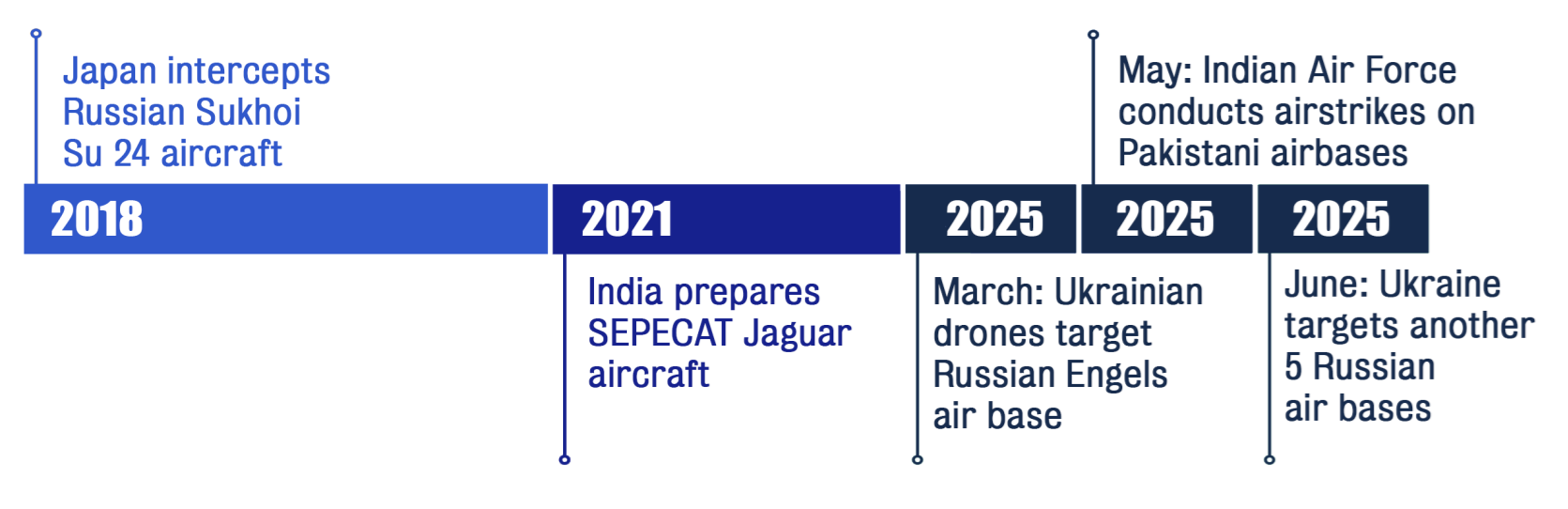
Even though aircraft capable of carrying nuclear weapons attract attention, real-world incidents are rare, and none of the following involved actual nuclear weapons. Here is a look at notable events over the last decade, in chronological order:
In December 2018, the Japan Air Self‑Defense Force scrambled jets to intercept a Russian Sukhoi Su‑24 strike aircraft. This is a platform capable of carrying nuclear weapons, which was conducting patrols over international waters near the Sea of Japan. Russian planes did not enter Japanese airspace, and the intercept was purely a defensive measure.
In November 2021, India ‘activated’ its ageing SEPECAT Jaguar fighter-bombers. ‘Activated’ here means that he aircraft and crews were made fully operational and trained to perform their strategic missions if ever required – not that the planes were armed with nuclear weapons. This action was part of broader readiness and deterrence measures during a period of heightened tensions with China.
In March 2025, a Ukrainian drone strike targeted the Engels air base near Saratov, home to Russia’s Tu‑160 “Blackjack” strategic bombers. The attack triggered a large explosion and fire, injuring civilians and prompting emergency responses. While the bombers are nuclear-capable, there is no evidence they were armed with nuclear weapons at the time.
In May 2025, during ‘Operation Sindoor,’ the Indian Air Force conducted airstrikes on multiple Pakistani airbases, including Nur Khan, Bholari, and Sargodha, damaging runways and infrastructure. These strikes targeted conventional military assets; there is no credible evidence that nuclear weapons or nuclear-capable aircraft were directly involved. The primary reason ‘nuclear’ came into the discussion, was because of India and Pakistan’s status as nuclear weapon states.
In all of these cases, no nuclear weapons were used, and there is no verifiable indication that any aircraft were armed with nuclear warheads at the time of the incidents. Social media and news commentary sometimes exaggerate the scale or implications, creating information disorder.
What to do with nuclear headlines
For readers encountering news or social media posts about nuclear-capable aircraft, here are some practical recommendations:
Check the source and check the tone. Could someone on social media be trying to grab your attention? Is it conspiracy Reddit, or is it BBC Verify? Then cross-check against government releases, and do a reverse image search to make sure you are not looking at Arma 3 footage.
Also consider the context in which you are seeing this. Conflicts or strategic exercises may trigger attention, but the operational and political reality of the situation will often explain the story more than the raw footage or viral posts.
When unsure, pause before sharing, and look for information. Read up on definitions and distinctions. Nuclear-capable does not mean nuclear-armed. Most incidents involve conventional operations, training, or symbolic signalling. If you type your question into Google, odds are you will come across a policy expert who has done an explainer on the technical term that’s confusing you.
By keeping these steps in mind, you can approach news about nuclear-capable aircraft – or indeed, most nuclear-related subject matter – more critically and gain a more accurate understanding of strategic military issues.
With thanks to Arun Dawson and Michael Abrahams for proofreading and editing.