Polymarket and CBRN risk: why the odds cannot be trusted
Prediction markets rest on a seductive idea: that aggregating the financial commitments of large numbers of individuals produces forecasts more accurate than those of any single expert or institution. But do they actually democratise access to information? And how do they impact diplomatic processes and decision-making in the CBRN domain?
Background
Part of the theoretical foundation of this case is the so-called “wisdom of crowds” – the idea that collective judgement can outperform individual judgment, provided that the crowd is sufficiently diverse, independent, and dispersed.
Platforms like Polymarket and Kalshi have built multi-billion-dollar enterprises on the extension of the crowd wisdom hypothesis to geopolitical forecasting. They market themselves as information infrastructure, a real-time signal that outperforms polls and government agencies. However, positioning prediction markets as superior to intelligence has turned out to be reputationally precarious – considering that the events being traded include active military conflicts and mass casualty threats. In response, Polymarket’s CEO Shayne Coplan offered a telling reframing at MIT Sloan Sports Analytics Conference, recounting that people in the Middle East use the platform odds to decide whether to sleep near bomb shelters – a statement he presented as evidence of social and humanitarian value.
Regardless of the sincerity of this argument, the question of whether prediction markets can function as accurate information aggregators requires a brief overview of their architecture.
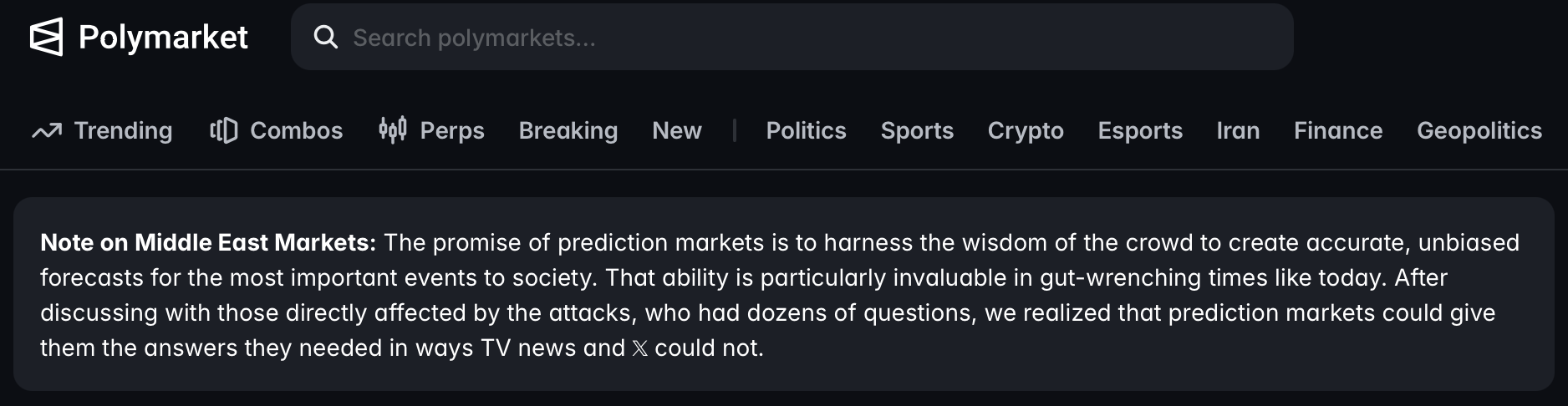
Image: a screenshot of the Polymarket “Note on Middle East Markets”, which frames the platform as an invaluable information aggregator in conflict-ridden zones.
On prediction markets, users trade “event contracts,” which are binary yes/no positions on a specified outcome, in a peer-to-peer structure where the platform does not act as a proper counterparty. Prices are set by supply and demand: a contract trading at 70 cents on the “yes” side implies, by the platform’s logic, a 70% probability of the underlying event.
In practice, these markets are neither fully decentralised nor genuinely flat. Profitability is highly concentrated: a Wall Street Journal analysis found that 0.1% of accounts captured 67% of Polymarket profits, while more than 70% of participants lost money. Median losses are, on average, worse than traditional sports betting. A 2026 study identified statistically anomalous trading patterns associated with an estimated $143 million in aggregate profit between February 2024 and February 2026. Analysis by the Anti Corruption Data Collective also found systemic insider trading indicators in betting on military and political outcomes specifically.
While none of this automatically disqualifies the aggregation claim, it does suggest that the conditions under which prediction markets could produce genuine collective wisdom — diversity, independence and dispersal of knowledge — are unevenly met. As such, there is a gap between the epistemic ideal and institutional reality in one of the most demanding contexts: chemical, biological, radiological and nuclear (CBRN) threats. In this domain, errors and distortions in how risk is probabilised can generate mass fear - not to mention reshape diplomatic calculations and eventually feed back into escalation dynamics.
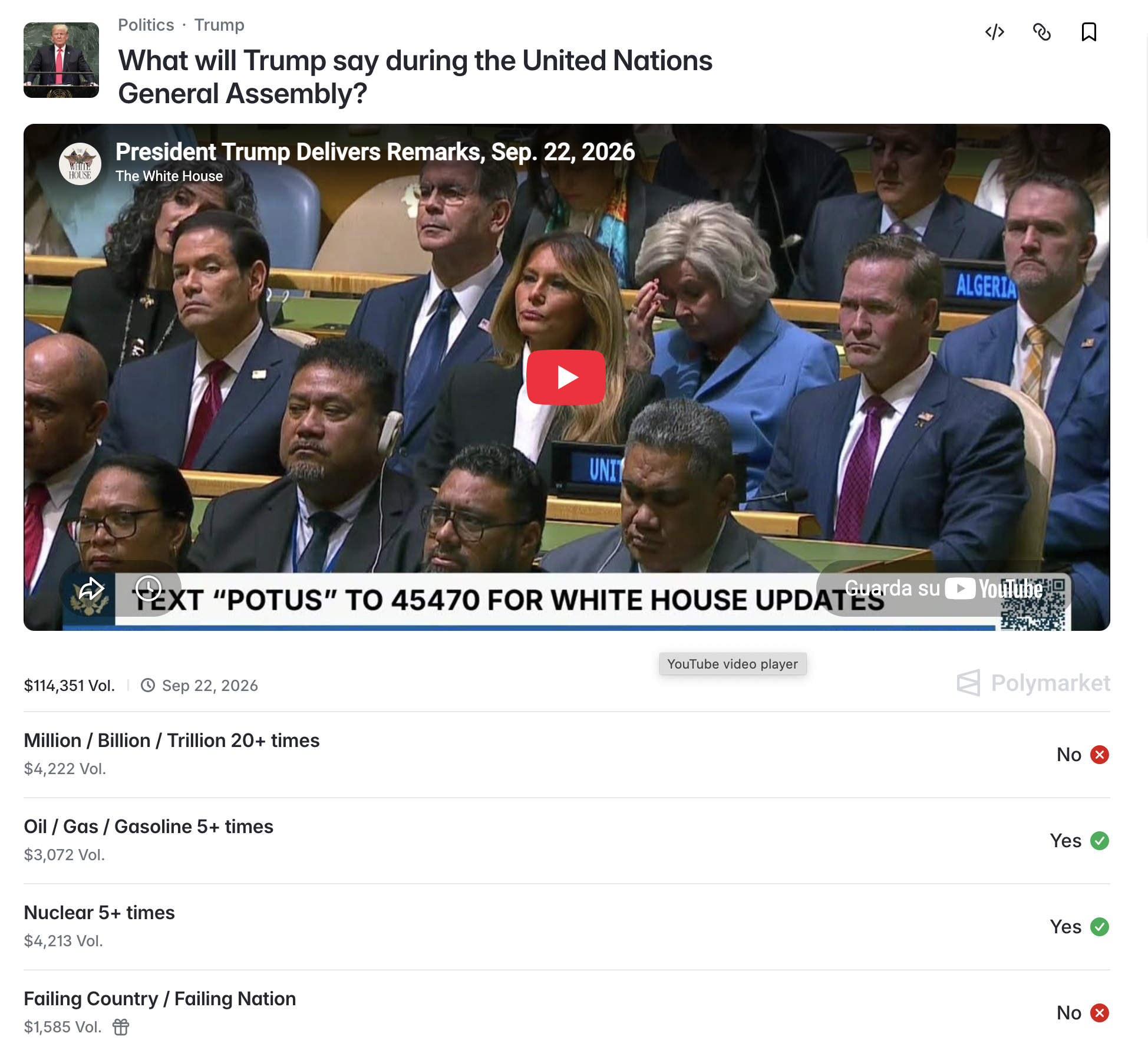
Image: a recent Polymarket contract featuring separate markets on whether President Donald J. Trump would use specific words or phrases – including the word “nuclear” – during his UN General Assembly speech.
The aggregation promise and its structural limits
The biosecurity domain offers an interesting example of the market holding the line through several genuine alarm spikes: Polymarket has run a series of contracts asking whether the World Health Organization (WHO) would declare H5N1 a pandemic, with deadlines at the end of 2024 and again at July 2025. Both contracts resolved to no: although the state of California declared a state of emergency over bird flu in December 2024, the outcome was consistent with the absence of sustained human-to-human transmission sufficient to prompt a WHO pandemic declaration.
However, accuracy does not exempt from reflecting on the market’s structural and epistemological boundaries – in other words, who can bet on what and who gets to determine the outcome? Interestingly, while Polymarket users are encouraged to suggest new ideas on social media, they cannot directly create a new market. A dedicated “Markets Team” functions as a filter for what is profitable and “bettable,” converting non-binary geopolitical realities into data-centric yes/no questions. The platform makes all the decisions that determine what counts as a “pandemic” or a “confirmed” attack before any trading begins, embedding epistemic choices that are invisible to participants and audiences.
Prices, on the other hand, often aggregate motivations rather than beliefs: a trader hedging against escalation, a speculator riding sentiment and an analyst conducting genuine risk assessment all produce the same market signal, with no way to distinguish between them. Large pseudonymous holders (commonly referred to as “whales”) can move prices single-handedly, generating an illusion of collective wisdom that may only reflect one well-resourced position.
Finally, when outcomes are genuinely ambiguous – which is frequently the case in CBRN contexts – the resolution can be contested. To verify the conditions that need to be met to resolve a contract, Polymarket uses an external system called UMA (Universal Market Access) Oracle. Participants can suggest an outcome, normally by staking a $750 bond; if the proposal is disputed, it triggers a verification mechanism that relies on UMA token-holders to vote on the final result. Beyond being disproportionately influenced by capital asymmetry, this procedure also incentivises UMA voters to follow prevailing consensus: participants who vote with the majority are rewarded, while those on the losing side (whether due to dishonesty or inaccurate assessment) risk losing part of their staked tokens. A market shaped by these dynamics cannot plausibly satisfy the prerequisites for genuine collective wisdom – diversity, independence and dispersal of crowd members.
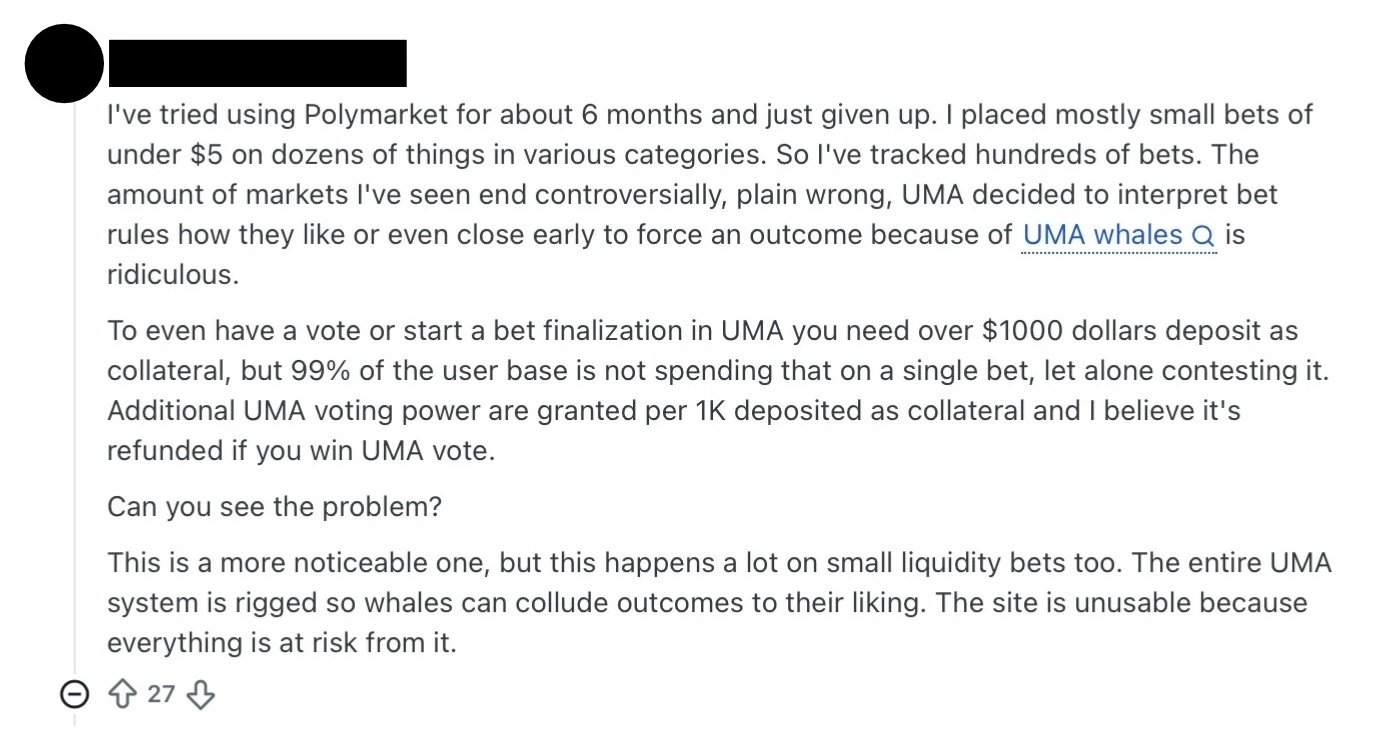
Image: screenshot of a disappointed user commenting on his experience with Polymarket and the UMA Oracle on r/Cryptocurrency.
A perfect example of the distortive nature of this mechanism can be found in the Fordow dispute: the contract regarding the destruction of the Fordow Fuel Enrichment Plant (FFEP) in Iran resolved to “yes” on 29 June 2025 after repeated contestations, notably in the absence of any official confirmation from Iran or the International Atomic Energy Agency (IAEA), with users alleging manipulation by UMA whales. While the rules did allow “a wide consensus of reporting” to resolve the market, the broad formulation casts doubt on the arbitrariness of the process.
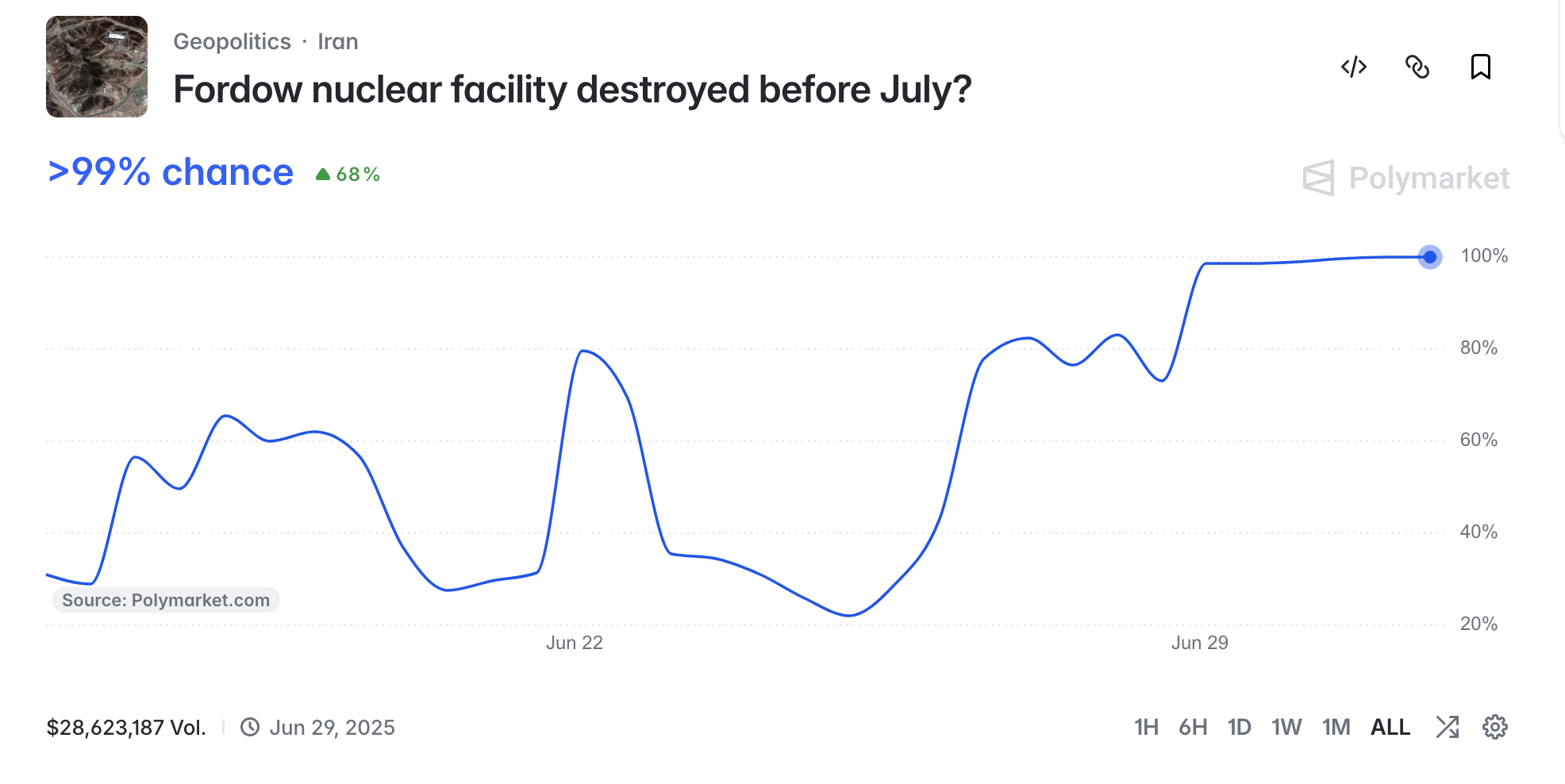
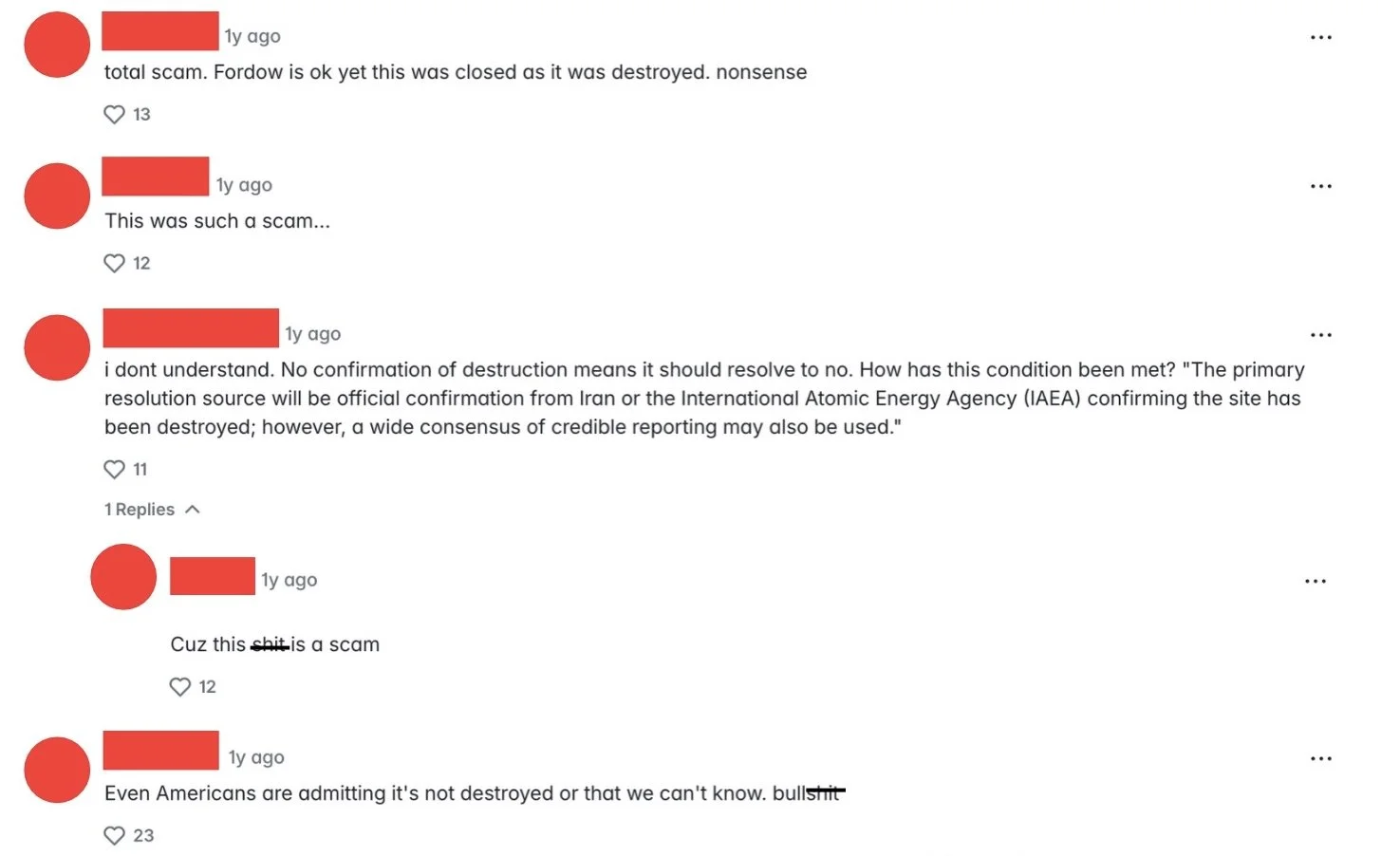
Images: Polymarket contract on the destruction of the Fordow Fuel Enrichment Plant (FFEP) in Iran, which sparked controversy over the transparency of the UMA Oracle resolution process. Some highly pertinent comments are included.
From signal to noise: harmful amplification and the feedback loop
As most CBRN contexts are highly nuanced, the more important question is what prediction markets do to the information ecosystem even when they are directionally correct.
Consider Russia’s nuclear signaling during the Ukraine war. From October 2022 onward, each round of escalatory rhetoric generated news coverage that explicitly cited Polymarket odds as a measure of nuclear risk. Although the market held a low probability throughout, Russian nuclear posturing had acquired a quantified, tradeable valence in public discourse that it did not have before; signals that might once have been contextualised by arms control experts were now mediated through a single percentage affected by each new provocation.
The COVID-19 lab leak markets illustrate a subtler version of the same problem. The “COVID lab leak confirmed by US in 2024?” contract attracted over $690,000 in trading volume before resolving to “no,” as no intelligence agency met the evidentiary threshold for confirmation. Nevertheless, the contract’s framing implicitly legitimised the hypothesis by making it tradable in the first place, at a moment when the share of American believing in lab origin had risen significantly. The subsequent Hantavirus lab leak contract suggests this is a repeating structural feature of the platform’s biological threat coverage.
Lastly, the Iran coverage illustrates the feedback loop argument in its sharpest form. Single point percentages were routinely reported, often without any uncertainty framing, and without considering a perverted consequence: policymakers infer information from prices, while their policy responses can, in turn, affect prices and the information traders reveal. As Polymarket published, for example, separate yes/no contracts on Iranian targeting of the UAE, Saudi Arabia, Jordan, etc., governments in those countries may have faced political pressure to respond to the signal, regardless of what their own intelligence indicated. The odds became a diplomatic factor liable to hinder de-escalation and peace negotiation processes.
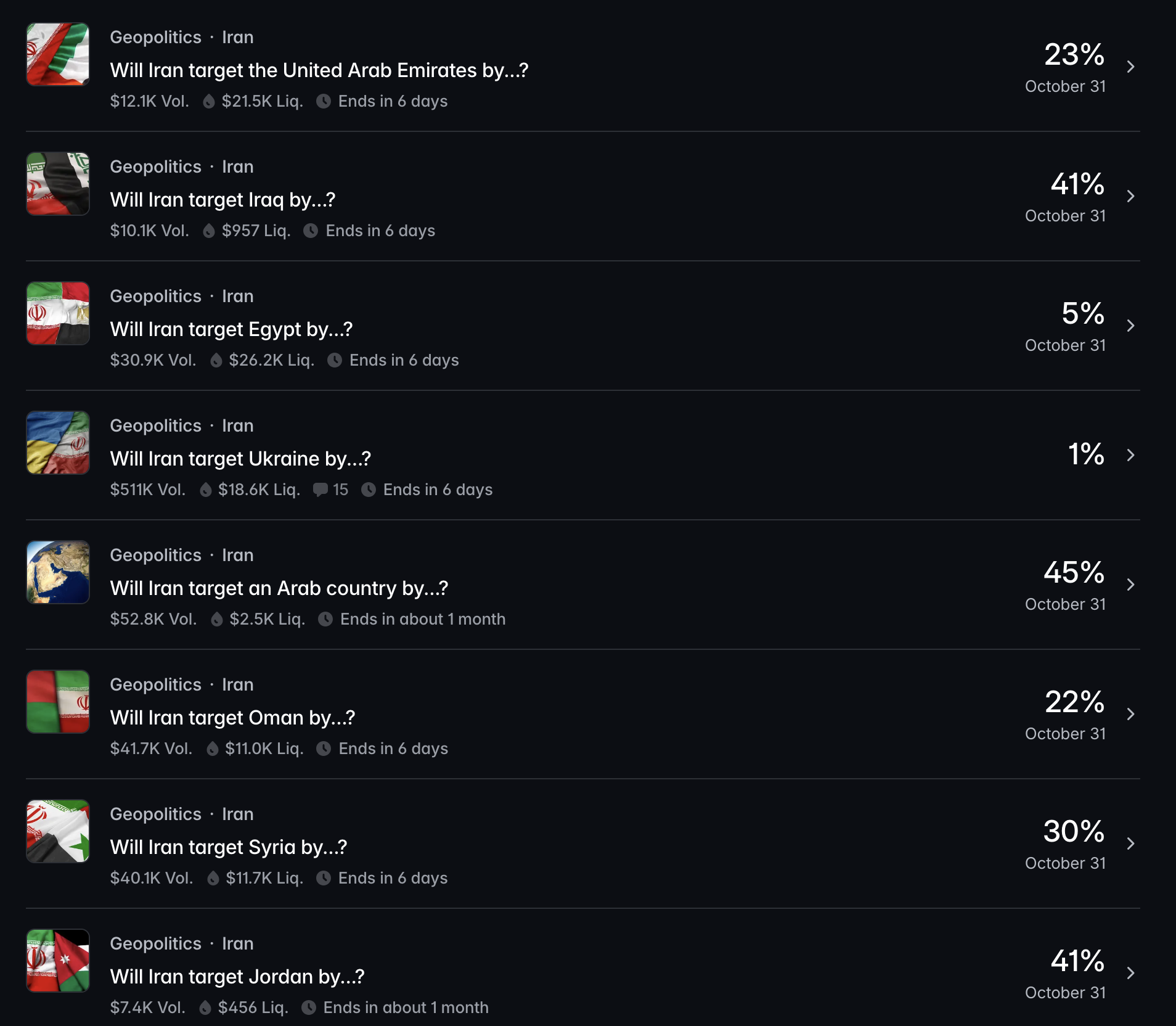
Image: Polymarket results after typing “will iran target” in the search bar, 24 September 2026.
The platform as an actor and the incentive inversion problem
The dynamics described so far illustrate how prediction markets interact with the information environment; but what about the platform as an active participant in that environment? This requires a dive into the structural conditions that make CBRN markets exploitable by actors with the resources and incentives to do so.
The most direct and visible example can be drawn, likewise, from recent media coverage of the conflict in Iran. On February 28, 2026, as US and Israeli airstrikes killed Supreme Leader Khamenei, Polymarket reportedly promoted a post on X citing a 22% probability of a nuclear weapon being detonated by the end of the year. The figure reflected market conditions during an acute shock rather than any genuine expert assessment of nuclear probability; nevertheless, stripped of its context, it went viral.
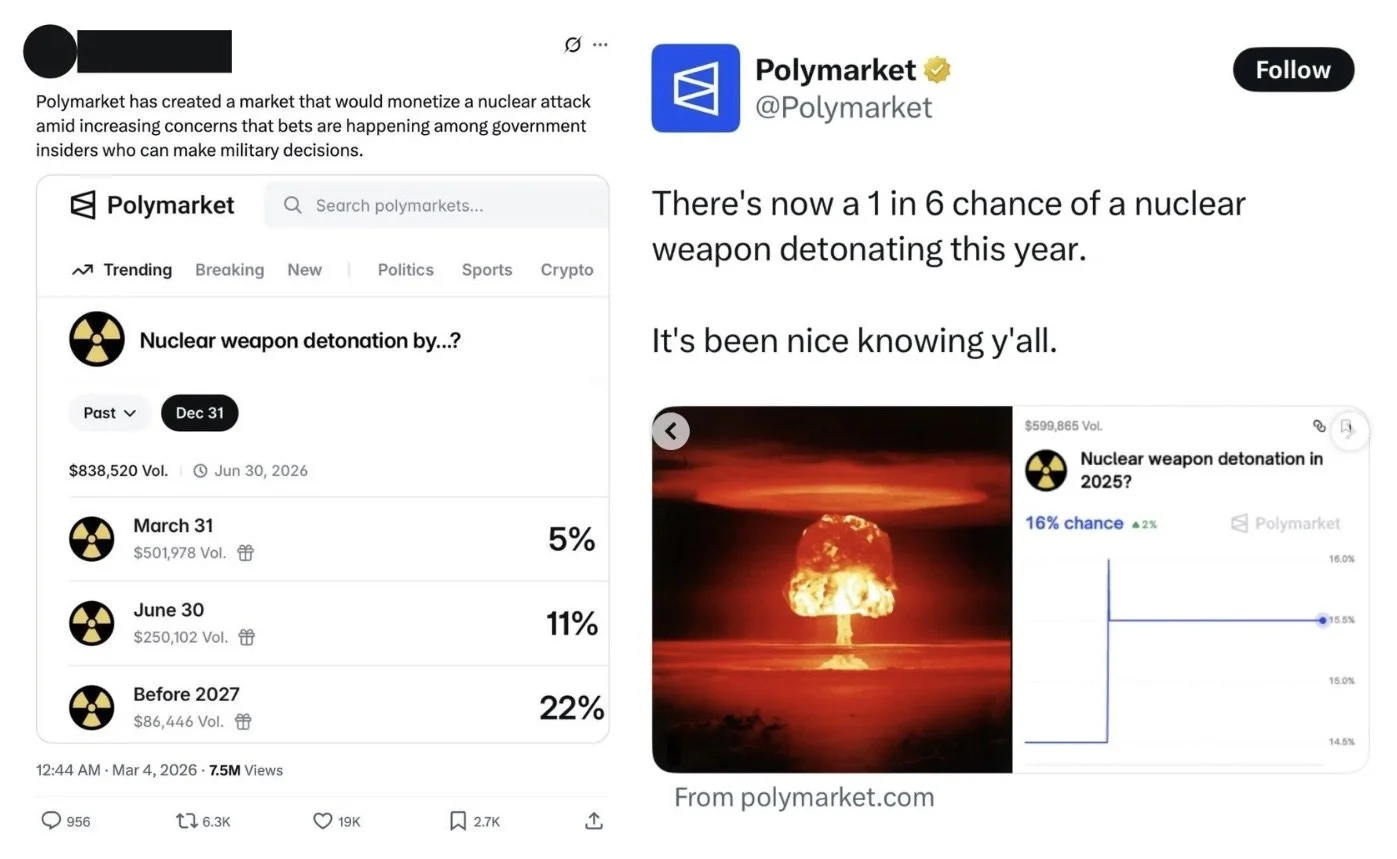
Images: on the left, a viral X post showing Polymarket's contract on nuclear detonation in March 2026; on the right, a viral Instagram post by @wasted concerning Polymarket’s nuclear detonation contract resolving by the end of 2025.
The post was subsequently deleted and the underlying market archived due to backlash, without any formal statement or correction. This dynamic of viral amplification and silent deletion is analogous to how other forms of disinformation propagate, regardless of intent.
The insider trading record introduces a more deliberate dimension. Blockchain analytics identified six accounts that profited approximately $1.2 million in the hours before the February 2026 strikes, and a single account that made over $553,000 betting on Khamenei specifically. In Israel an IDF reservist and a civilian were indicted for using classified military intelligence to place Polymarket wagers. The consequences for the information ecosystem go beyond financial harm: these episodes generate a credible public narrative that Polymarket odds function as a leaked-intelligence channel, which now shapes how journalists and policymakers read every marker on the platform. The EVIDENCE Network itself has received several media requests to comment on this.
Ultimately, the boundary between the market and the event it purports to observe is not stable, and both the platform and its participants have demonstrated the capacity to act on either side of it simultaneously. In a market on nuclear use or a chemical attack, actors with positions could conceivably influence the underlying event, and, at the same time, the visibility of the odds could enter the escalation calculus of the parties being watched. This “incentive inversion” problem has been observed before: in 2003, US Congress shut down DARPA’s Policy Analysis Market (PAM) – established in 2001 as part of the Future Markets Applied to Prediction project – on the grounds that a geopolitical prediction market could incentivise actors to profit from political violence before carrying it out. The logic behind this criticism is still applicable; however, while PAM was closed before any trader could register, Polymarket’s cumulative volume since launch is estimated at $8–12 billion. As of April 2026, political markets accounted for a disproportionate share of trading activity on Polymarket, generating over 36% of total trading volume despite representing only 4% of contracts.
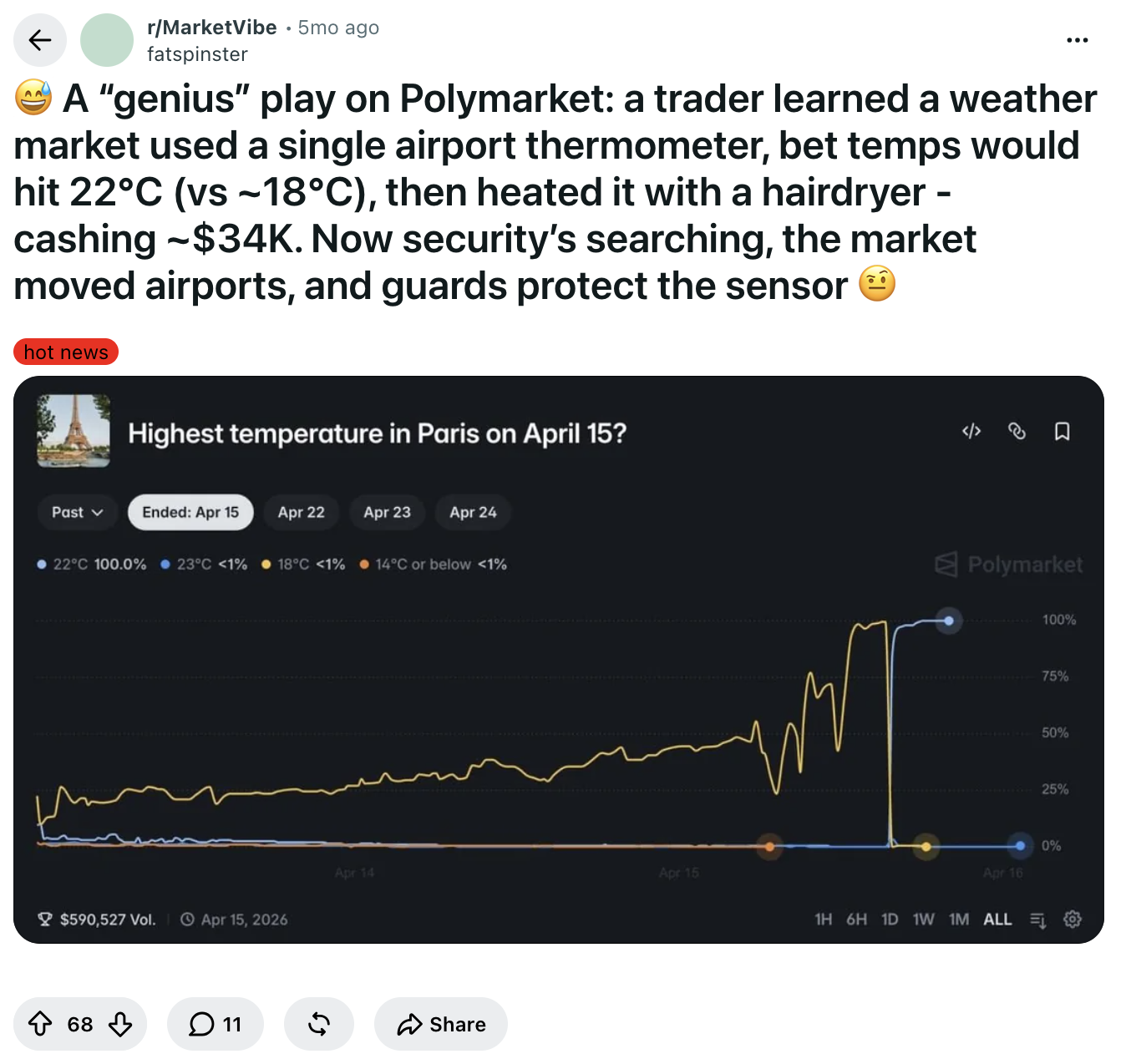
Image: a humorous, non-CBRN example of the incentive inversion problem as reported by CNN - the payoff mechanism potentially transforms the participant’s goal from accurately predicting a measurement to manipulating it. Here, the reddit thread.
Conclusions and recommendations
Prediction markets are not neutral instruments. In domains where underlying events are benign, the aggregation function they claim to perform is both plausible and relatively harmless. In the CBRN domain, neither condition holds: the signals being aggregated are entangled with classified information, state propaganda, thin market noise and insider positioning that the platform cannot distinguish from genuine collective wisdom. The consequences of getting those signals wrong range from amplified public fear to civilian shelter decisions made on the basis of speculative training data. Ironically, the allegations of White House insider trading on Polymarket exacerbate this dynamic rather than resolving it. For a civilian audience already inclined to treat market odds as a signal of privileged knowledge, insider trading allegations function as a perverse form of validation, lending dangerous authority to numbers whose provenance remains opaque.
As a result, prediction markets in high-stakes contexts are dual-use infrastructure: the same mechanism that might, under ideal conditions, improve collective understanding can also, under adversarial or simply chaotic conditions, accelerate the very dynamics it seeks to observe.
To foster responsible engagement with Polymarket data on CBRN topics, we recommend that readers:
Treat every probability as a noisy, financially motivated signal, subject to the same criticism applied to anonymous intelligence claims. Who profits from the circulation of these market odds? Could there be any ulterior incentive?
Think critically about how the platform frames questions and how that framing influences the outcome. For example, what do words like “confirmed”, “destructed”, “declared”, “pandemic” etc. really mean?
Question the transparency of the UMA Oracle resolution process and independently verify market outcomes; look for original sources and cross-reference multiple reputable outlets.
Resist the temptation to flatten epistemic complexity into a single, tradeable probability: remember that the appearance of numerical precision can hide substantial underlying ambiguity.